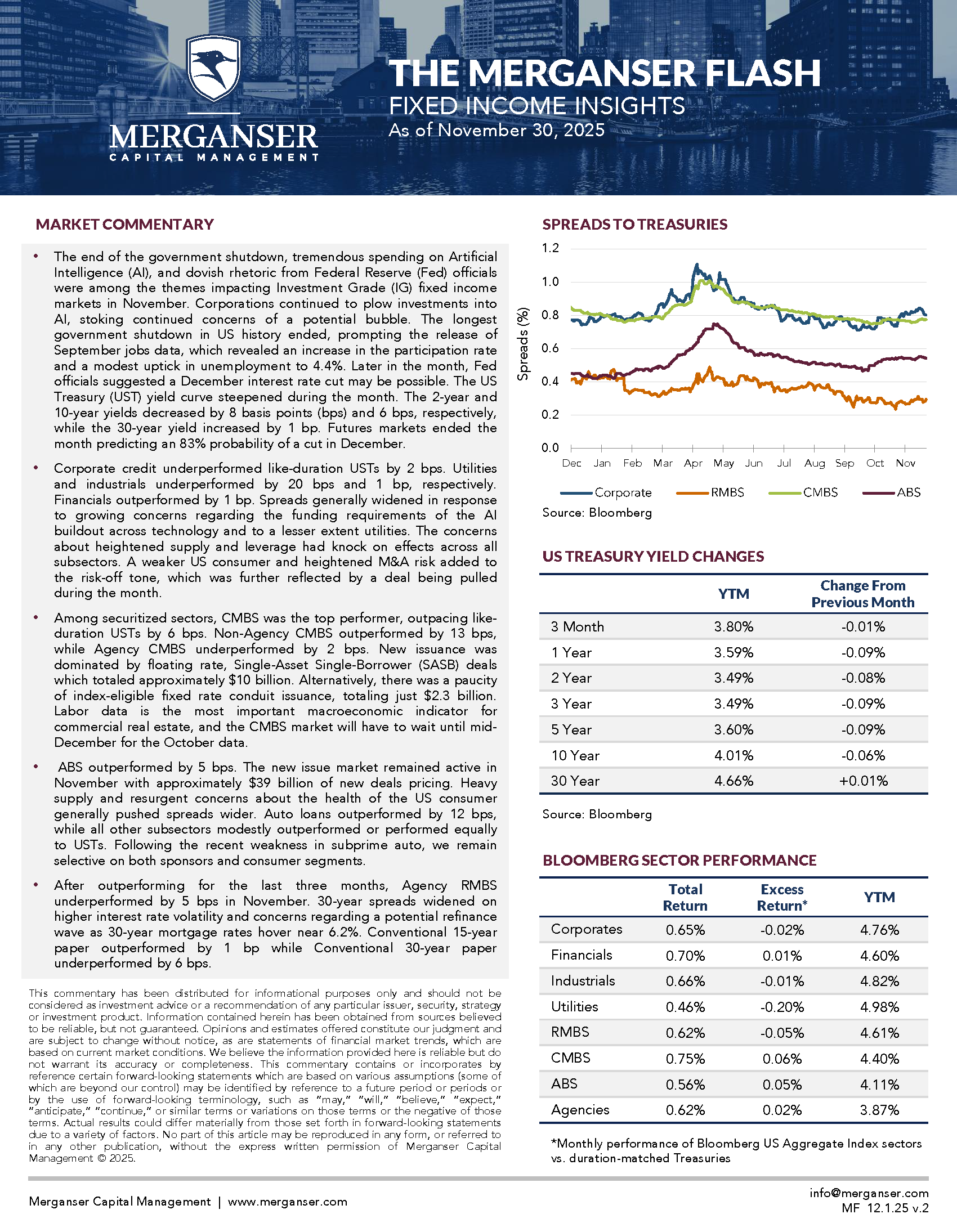
- The end of the government shutdown, tremendous spending on Artificial Intelligence (AI), and dovish rhetoric from Federal Reserve (Fed) officials were among the themes impacting Investment Grade (IG) fixed income markets in November. Corporations continued to plow investments into AI, stoking continued concerns of a potential bubble. The longest government shutdown in US history ended, prompting the release of September jobs data, which revealed an increase in the participation rate and a modest uptick in unemployment to 4.4%. Later in the month, Fed officials suggested a December interest rate cut may be possible. The US Treasury (UST) yield curve steepened during the month. The 2-year and 10-year yields decreased by 8 basis points (bps) and 6 bps, respectively, while the 30-year yield increased by 1 bp. Futures markets ended the month predicting an 83% probability of a cut in December.
- Corporate credit underperformed like-duration USTs by 2 bps. Utilities and industrials underperformed by 20 bps and 1 bp, respectively. Financials outperformed by 1 bp. Spreads generally widened in response to growing concerns regarding the funding requirements of the AI buildout across technology and to a lesser extent utilities. The concerns about heightened supply and leverage had knock on effects across all subsectors. A weaker US consumer and heightened M&A risk added to the risk-off tone, which was further reflected by a deal being pulled during the month.
- Among securitized sectors, CMBS was the top performer, outpacing like-duration USTs by 6 bps. Non-Agency CMBS outperformed by 13 bps, while Agency CMBS underperformed by 2 bps. New issuance was dominated by floating rate, Single-Asset Single-Borrower (SASB) deals which totaled approximately $10 billion. Alternatively, there was a paucity of index-eligible fixed rate conduit issuance, totaling just $2.3 billion. Labor data is the most important macroeconomic indicator for commercial real estate, and the CMBS market will have to wait until mid-December for the October data.
- ABS outperformed by 5 bps. The new issue market remained active in November with approximately $39 billion of new deals pricing. Heavy supply and resurgent concerns about the health of the US consumer generally pushed spreads wider. Auto loans outperformed by 12 bps, while all other subsectors modestly outperformed or performed equally to USTs. Following the recent weakness in subprime auto, we remain selective on both sponsors and consumer segments.
- After outperforming for the last three months, Agency RMBS underperformed by 5 bps in November. 30-year spreads widened on higher interest rate volatility and concerns regarding a potential refinance wave as 30-year mortgage rates hover near 6.2%. Conventional 15-year paper outperformed by 1 bp while Conventional 30-year paper underperformed by 6 bps.