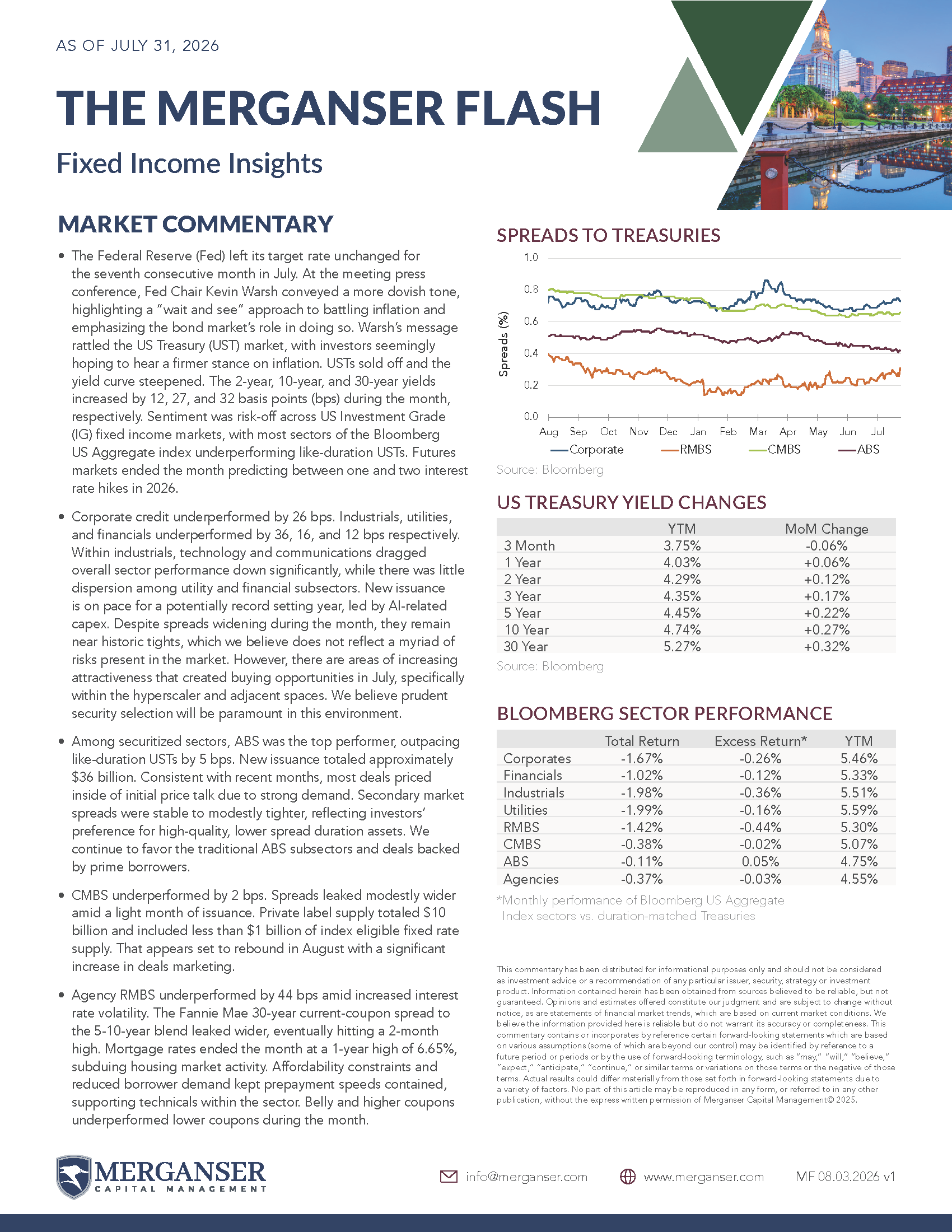
- The Federal Reserve (Fed) left its target rate unchanged for the seventh consecutive month in July. At the meeting press conference, Fed Chair Kevin Warsh conveyed a more dovish tone, highlighting a “wait and see” approach to battling inflation and emphasizing the bond market’s role in doing so. Warsh’s message rattled the US Treasury (UST) market, with investors seemingly hoping to hear a firmer stance on inflation. USTs sold off and the yield curve steepened. The 2-year, 10-year, and 30-year yields increased by 12, 27, and 32 basis points (bps) during the month, respectively. Sentiment was risk-off across US Investment Grade (IG) fixed income markets, with most sectors of the Bloomberg US Aggregate index underperforming like-duration USTs. Futures markets ended the month predicting between one and two interest rate hikes in 2026.
- Corporate credit underperformed by 26 bps. Industrials, utilities, and financials underperformed by 36, 16, and 12 bps respectively. Within industrials, technology and communications dragged overall sector performance down significantly, while there was little dispersion among utility and financial subsectors. New issuance is on pace for a potentially record setting year, led by AI-related capex. Despite spreads widening during the month, they remain near historic tights, which we believe does not reflect a myriad of risks present in the market. However, there are areas of increasing attractiveness that created buying opportunities in July, specifically within the hyperscaler and adjacent spaces. We believe prudent security selection will be paramount in this environment.
- Among securitized sectors, ABS was the top performer, outpacing like-duration USTs by 5 bps. New issuance totaled approximately $36 billion. Consistent with recent months, most deals priced inside of initial price talk due to strong demand. Secondary market spreads were stable to modestly tighter, reflecting investors’ preference for high-quality, lower spread duration assets. We continue to favor the traditional ABS subsectors and deals backed by prime borrowers.
- CMBS underperformed by 2 bps. Spreads leaked modestly wider amid a light month of issuance. Private label supply totaled $10 billion and included less than $1 billion of index eligible fixed rate supply. That appears set to rebound in August with a significant increase in deals marketing.
- Agency RMBS underperformed by 44 bps amid increased interest rate volatility. The Fannie Mae 30-year current-coupon spread to the 5-10-year blend leaked wider, eventually hitting a 2-month high. Mortgage rates ended the month at a 1-year high of 6.65%, subduing housing market activity. Affordability constraints and reduced borrower demand kept prepayment speeds contained, supporting technicals within the sector. Belly and higher coupons underperformed lower coupons during the month.