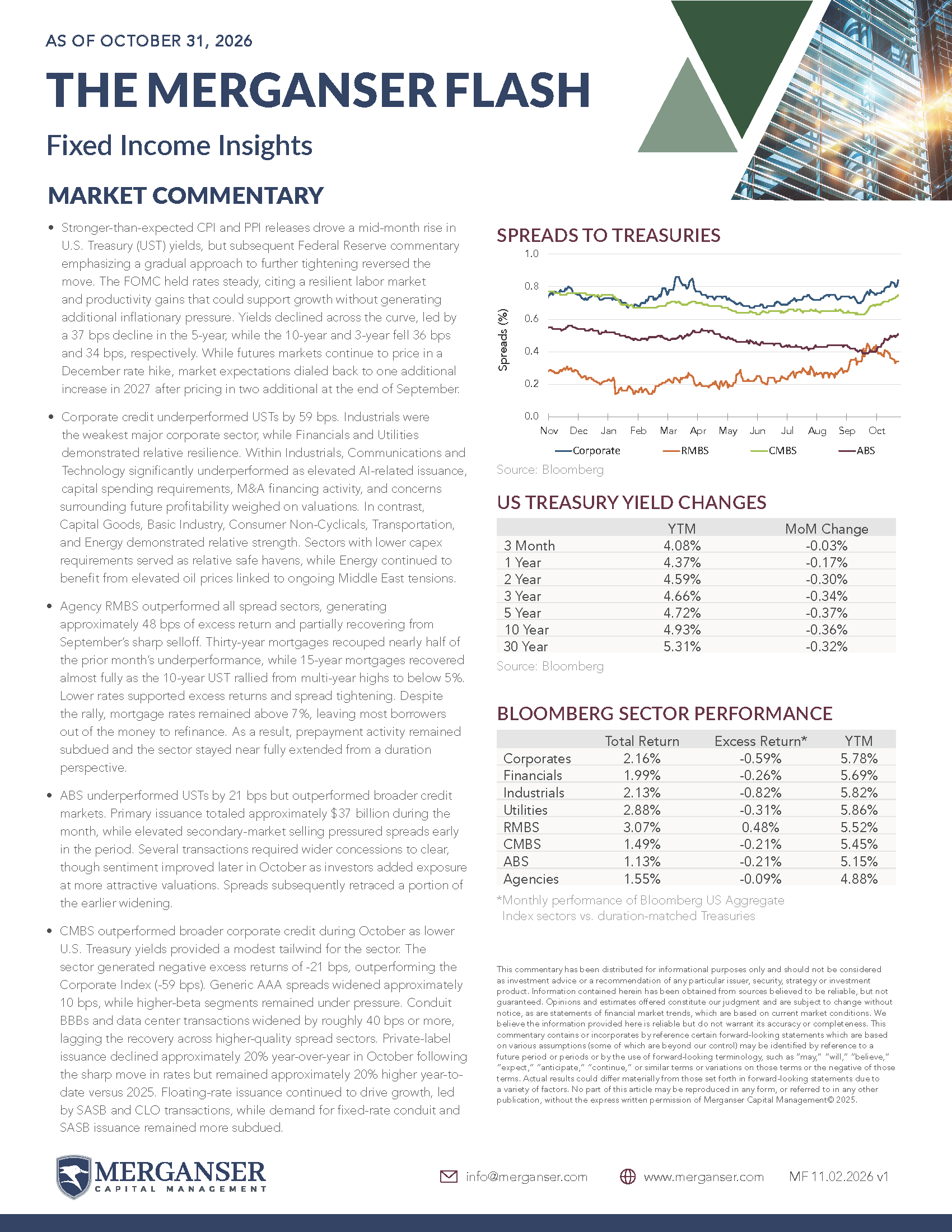
- Stronger-than-expected CPI and PPI releases drove a mid-month rise in U.S. Treasury (UST) yields, but subsequent Federal Reserve commentary emphasizing a gradual approach to further tightening reversed the move. The FOMC held rates steady, citing a resilient labor market and productivity gains that could support growth without generating additional inflationary pressure. Yields declined across the curve, led by a 37 bps decline in the 5-year, while the 10-year and 3-year fell 36 bps and 34 bps, respectively. While futures markets continue to price in a December rate hike, market expectations dialed back to one additional increase in 2027 after pricing in two additional at the end of September.
- Corporate credit underperformed USTs by 59 bps. Industrials were the weakest major corporate sector, while Financials and Utilities demonstrated relative resilience. Within Industrials, Communications and Technology significantly underperformed as elevated AI-related issuance, capital spending requirements, M&A financing activity, and concerns surrounding future profitability weighed on valuations. In contrast, Capital Goods, Basic Industry, Consumer Non-Cyclicals, Transportation, and Energy demonstrated relative strength. Sectors with lower capex requirements served as relative safe havens, while Energy continued to benefit from elevated oil prices linked to ongoing Middle East tensions.
- Agency RMBS outperformed all spread sectors, generating approximately 48 bps of excess return and partially recovering from September’s sharp selloff. Thirty-year mortgages recouped nearly half of the prior month’s underperformance, while 15-year mortgages recovered almost fully as the 10-year UST rallied from multi-year highs to below 5%. Lower rates supported excess returns and spread tightening. Despite the rally, mortgage rates remained above 7%, leaving most borrowers out of the money to refinance. As a result, prepayment activity remained subdued and the sector stayed near fully extended from a duration perspective.
- ABS underperformed USTs by 21 bps but outperformed broader credit markets. Primary issuance totaled approximately $37 billion during the month, while elevated secondary-market selling pressured spreads early in the period. Several transactions required wider concessions to clear, though sentiment improved later in October as investors added exposure at more attractive valuations. Spreads subsequently retraced a portion of the earlier widening.
- CMBS outperformed broader corporate credit during October as lower U.S. Treasury yields provided a modest tailwind for the sector. The sector generated negative excess returns of -21 bps, outperforming the Corporate Index (-59 bps). Generic AAA spreads widened approximately 10 bps, while higher-beta segments remained under pressure. Conduit BBBs and data center transactions widened by roughly 40 bps or more, lagging the recovery across higher-quality spread sectors. Private-label issuance declined approximately 20% year-over-year in October following the sharp move in rates but remained approximately 20% higher year-to-date versus 2025. Floating-rate issuance continued to drive growth, led by SASB and CLO transactions, while demand for fixed-rate conduit and SASB issuance remained more subdued.