- US Treasury (UST) yields generally increased during August amid strong economic growth and persistent above-target inflation. Early in the month, a resurgence in oil prices brought inflation concerns to the forefront. Later in August, Treasury Secretary Scott Bessent announced that the government may use funds in its General Account to buy back longer maturity off-the-run USTs. On August 28th, Federal Reserve (Fed) Chair Kevin Warsh delivered hawkish remarks at the Jackson Hole Economic Policy Symposium, causing market participants to recalibrate expectations for monetary policy. The yield curve exhibited a twist for the month as 2 and 10-year yields increased by 5 and 2 basis points (bps), respectively, while the 30-year yield decreased by 3 bps. Sentiment was generally risk-on across US Investment Grade (IG) fixed income markets, with most sectors of the Bloomberg US Aggregate index outperforming like-duration USTs. Futures markets ended the month predicting between one and two interest rate hikes by year-end.
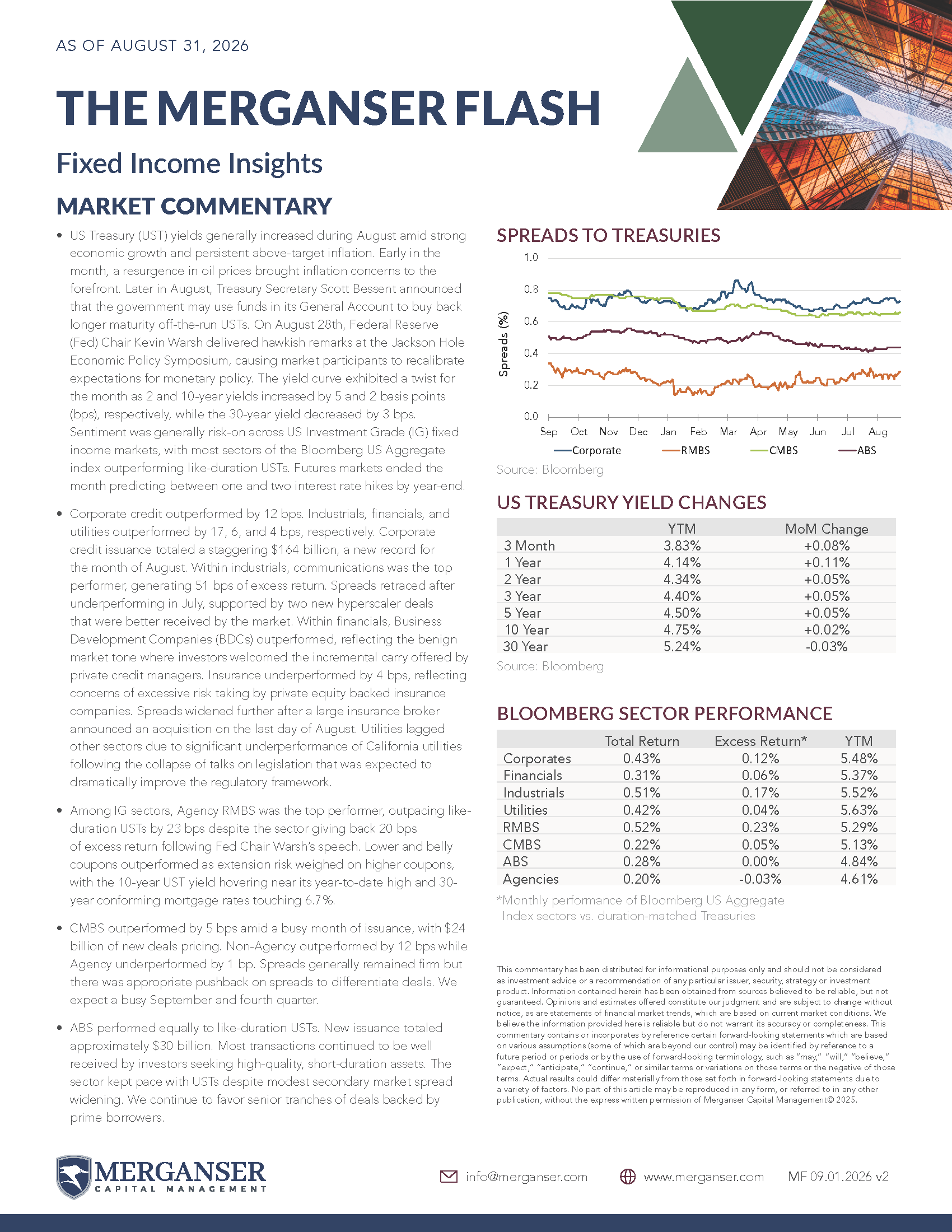
- Corporate credit outperformed by 12 bps. Industrials, financials, and utilities outperformed by 17, 6, and 4 bps, respectively. Corporate credit issuance totaled a staggering $164 billion, a new record for the month of August. Within industrials, communications was the top performer, generating 51 bps of excess return. Spreads retraced after underperforming in July, supported by two new hyperscaler deals that were better received by the market. Within financials, Business Development Companies (BDCs) outperformed, reflecting the benign market tone where investors welcomed the incremental carry offered by private credit managers. Insurance underperformed by 4 bps, reflecting concerns of excessive risk taking by private equity backed insurance companies. Spreads widened further after a large insurance broker announced an acquisition on the last day of August. Utilities lagged other sectors due to significant underperformance of California utilities following the collapse of talks on legislation that was expected to dramatically improve the regulatory framework.
- Among IG sectors, Agency RMBS was the top performer, outpacing like-duration USTs by 23 bps despite the sector giving back 20 bps of excess return following Fed Chair Warsh’s speech. Lower and belly coupons outperformed as extension risk weighed on higher coupons, with the 10-year UST yield hovering near its year-to-date high and 30-year conforming mortgage rates touching 6.7%.
- CMBS outperformed by 5 bps amid a busy month of issuance, with $24 billion of new deals pricing. Non-Agency outperformed by 12 bps while Agency underperformed by 1 bp. Spreads generally remained firm but there was appropriate pushback on spreads to differentiate deals. We expect a busy September and fourth quarter.
- ABS performed equally to like-duration USTs. New issuance totaled approximately $30 billion. Most transactions continued to be well received by investors seeking high-quality, short-duration assets. The sector kept pace with USTs despite modest secondary market spread widening. We continue to favor senior tranches of deals backed by prime borrowers.