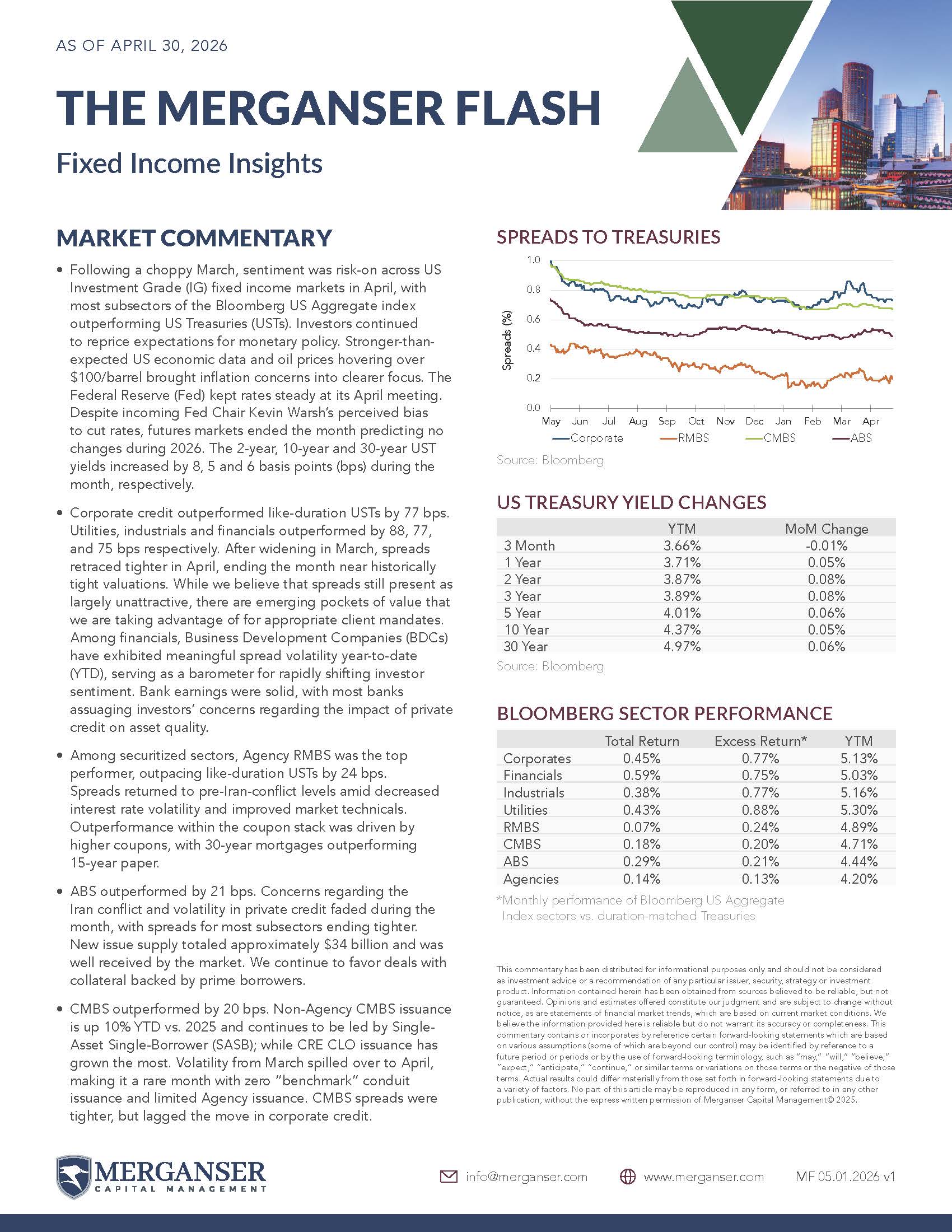
- Following a choppy March, sentiment was risk-on across US Investment Grade (IG) fixed income markets in April, with most subsectors of the Bloomberg US Aggregate index outperforming US Treasuries (USTs). Investors continued to reprice expectations for monetary policy. Stronger-than-expected US economic data and oil prices hovering over $100/barrel brought inflation concerns into clearer focus. The Federal Reserve (Fed) kept rates steady at its April meeting. Despite incoming Fed Chair Kevin Warsh’s perceived bias to cut rates, futures markets ended the month predicting no changes during 2026. The 2-year, 10-year and 30-year UST yields increased by 8, 5 and 6 basis points (bps) during the month, respectively.
- Corporate credit outperformed like-duration USTs by 77 bps. Utilities, industrials and financials outperformed by 88, 77, and 75 bps respectively. After widening in March, spreads retraced tighter in April, ending the month near historically tight valuations. While we believe that spreads still present as largely unattractive, there are emerging pockets of value that we are taking advantage of for appropriate client mandates. Among financials, Business Development Companies (BDCs) have exhibited meaningful spread volatility year-to-date (YTD), serving as a barometer for rapidly shifting investor sentiment. Bank earnings were solid, with most banks assuaging investors’ concerns regarding the impact of private credit on asset quality.
- Among securitized sectors, Agency RMBS was the top performer, outpacing like-duration USTs by 24 bps. Spreads returned to pre-Iran-conflict levels amid decreased interest rate volatility and improved market technicals. Outperformance within the coupon stack was driven by higher coupons, with 30‑year mortgages outperforming 15‑year paper.
- ABS outperformed by 21 bps. Concerns regarding the Iran conflict and volatility in private credit faded during the month, with spreads for most subsectors ending tighter. New issue supply totaled approximately $34 billion and was well received by the market. We continue to favor deals with collateral backed by prime borrowers.
- CMBS outperformed by 20 bps. Non-Agency CMBS issuance is up 10% YTD vs. 2025 and continues to be led by Single-Asset Single-Borrower (SASB); while CRE CLO issuance has grown the most. Volatility from March spilled over to April, making it a rare month with zero “benchmark” conduit issuance and limited Agency issuance. CMBS spreads were tighter, but lagged the move in corporate credit.